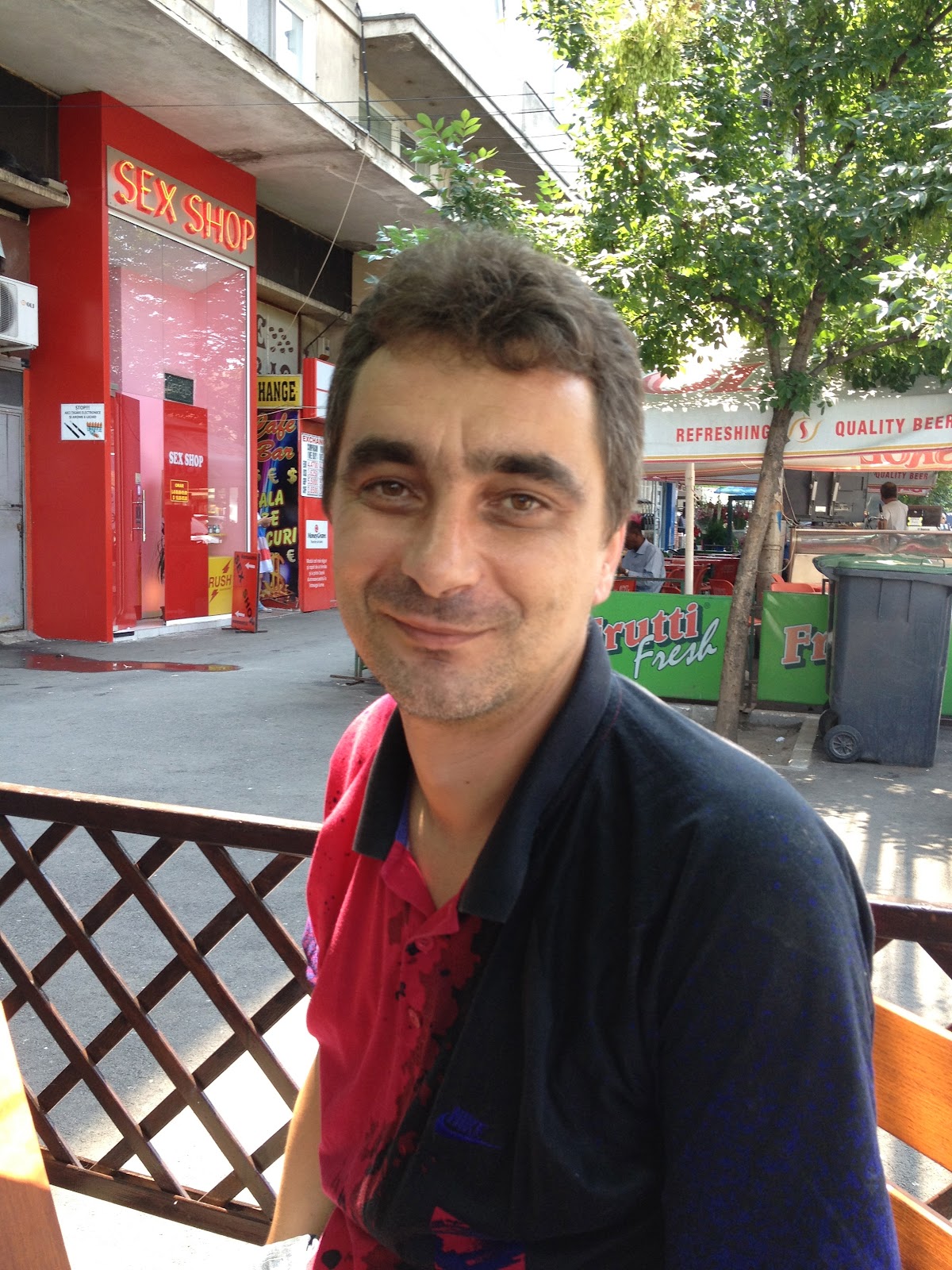
Sunday, July 15, 2012

Just Take Bus 106


Mini Buses
CHISINAU, MOLDOVA The hotel desk clerk tells me, “To get to the city take either the mini bus 106 or 160." The mini buses are all over the place, stopping whenever someone flags them down, and then continuing on some pre-planned, route, with which only the locals seem familiar. In minutes 106 appears. I flag it down, hop aboard, and give the driver three lei, less than a quarter. It looks like the right bus as the sign next to the 106 reads Piata Centrala and although the driver makes a variety of turns, I believe we’re heading in the right direction. So far so good — but then we come to a busy intersection where another bus pulls up beside us. The two drivers roll down their windows, talking and gesturing. They reach some sort of agreement and the passengers on the bus begin transferring to the other bus. “What the heck is going on?” But no English here, so I dumbly follow the crowd. The new bus takes a turn. It’s the wrong direction! I’m sure. The other passengers show no concern and continue to get on and off as if by plan. The bus finally stops. We are in a sparsely populated area with only a few buildings around. The passengers get off. I wait to talk to the driver. I point to the sign on his window. “Centrala! centrala!” He shakes his head, gesturing and talking rapidly. I keep pointing at the sign, “Centrala!” Ah, finally he appreciates the fix I’m in and motions me to sit down. Alone we drive another fifteen minutes farther outside the city, where we arrive at a place where a number of mini buses are parked, their drivers relaxing in the shade. My driver talks to one of them, who finally nods his agreement and motions for me to get in his bus. Half-hour later we arrive at the Piata Centrala, and all this for less than two bits. I suppose from this you might guess that Chisinau is not somewhere you’d expect to run into many Americans, but that evening I did, on two separate occasions, and here’s what they had to say.

David with whom I had a beer: "I’m a bank examiner from Oklahoma on assignment here by the U.S. Treasury Department. These assignments are one to two months long and can take me just about anywhere in the world. My job is to help governments examine their banking books, establish policies to thwart corruption, and to analyze and report on the effectiveness of U.S. Treasury’s investments. A big issue is corruption, but then that’s true everywhere including America. We call it lobbying. The Treasury Department funnels money into a lot of projects. The folks back in Oklahoma might be dismayed to learn where their taxpayer dollars are going — building of a Mosque, fighting AIDs, or the distribution of birth control. Moldova is a very poor country — per capita income around $3,000. In five years it will definitely join the European Union, but it will probably have to give up Transnistria in order to do so. Might be easier if Moldova belonged to Romania. That’s where it belongs anyway. I’m sure it won’t become part of the Russian Federation again. Democracy here has developed too far, and the hard feelings toward the pre-independent days still linger."

Pat with whom I had dinner: "I’m a zoologist with a PhD from the University of Florida. I work as independent contractor conducting bio-diversity studies for the U.S. State Department. These assignments can take about a month and may be anywhere in the world. I usually do two or three a year. The rest of the time I write an article on bio diversity for my hometown newspaper in Florida. It’s kind of a nice setup that allows me to travel and do something I care about, without having to be away from home that much. I’m here to do research and write a report on a sturgeon caviar farm in Transnistria. The U.S. State Department wants to know what’s going on and whether it's meeting the obligations under the Convention on Biological Diversity, to which Moldova is a signature. The State Department may use this information to determine if they want to fund certain projects here. Since Transnistria is a place like no other place, having its own currency, political system, and yet not recognized as a country by anyone, I’m going there incognito, as a tourist. No one is to know I work for the State Department. It's an odd place. The people there don't even have passports. To leave they must use another country’s passport, like Ukraine or Russia."

Friday, July 13, 2012

Moldovian Crossing


Changing Wheels
MOLDOVIAN BOARDER It’s four in the morning. Someone is tapping on my foot. The cabin light flicks on. For a moment I forget where I am. I was sound asleep. Groggy, I recognize the train’s steward. He says, “pass,” probably the only English word he knows. Okay, I need to get out my passport. The steward leaves and fifteen minutes later a Romanian border guard comes by and takes my passport. Then nothing for an hour, until the Romanian border guard comes back with my passport and the train starts to move, slowly, for just a few minutes, then stops. I had closed my cabin door, thinking we were through. There’s another knock on the door. A woman in street attire points at herself and says, “doctor.” Then points at me, “problem?” I shake my head and she moves on. Uniformed men are now patrolling the corridor. A Russian soldier, that’s what I suspect anyway from the Russian star on his cap, motions for me to give him my passport. He studies it very seriously, and says something in Russian. It seems he wants to know where I’m going. I show him the numerous visas in my passport. He says something in Russian. I think he’s asking me, how long am I staying in Moldova. I hold up two fingers. He proceeds to page through my passport several times, with a curious frown, looking for something, I don’t know what. Finally he runs my passport through his computer and hands it back to me. I say Spasiba. He nods with a smile and moves on. A moment later another uniformed official, from which country I'm not sure, asks me to open my bags. He looks the contents over, satisfied, moves on. The train starts up again, moving slowly, stops for a few minutes, then backs up, and stops. There’s a loud clang outside, lots of commotion. Workers are changing the wheels on the train. We are now on the Russian rail system, whose track gauge is different than that of the West, a system that Tsar Nicholas I in the 1840s mandated so that their enemies could not use Russia’s rail system to attack them.

After the interminable delay we finally head into Moldova. Due in part to the lengthy boarding crossing, the train from Bucharest to Chisinau takes over thirteen hours. The train is old and has zero amenities: no air conditioning, no electrical outlets, no diner car, and toilets that dump their refuge on the open tracks below. It’s not for your everyday traveler. From Marius I learned that Moldova was once part of Romania. They speak the same language and use the same currency. It turns out he wasn't correct with respect to the currency. So don't believe everything you hear. Now in theory, at least, Moldova is an independent country although the northern region, Transnistria,dominated by Russians, wants to break away and become a part of the Russia Federation. Curiously, I don’t need a visa here, but I do need one for Russia. Yet it’s the Russian officials that controlled the border, and the tracks are Russian. So is Moldova Russian, Romanian, or independent? I put this question to the two desk clerks at the hotel where I’m staying. One said Moldova is Russian the other said we’re European. I also ran into a bank examiner working for the U.S. Treasury Department and he told me most certainly Moldova will become a part of the European Union. But I’m not so certain. If I were to put money on it, I would bet in a few years, it will return to Russia — just a hunch. 

Wednesday, July 11, 2012

Aren't You Lonely

BUCHAREST, ROMANIA The most frequently asked question I get is: aren’t you lonely when you travel alone? My answer is that I’m always bumping into someone with whom I can have a conversation and that often makes me feel more alive than talking with people I’ve known all my life. Today was a good example. After tramping through much of Bucharest alone, I stopped to get some lunch. The tables were full, so I asked a young man if I might share his table. His name turned out to be Marius and five hours later, after he had given me an extensive tour of the city, disabused me of most of my original impressions of Bucharest, and shared with me his opinions on everything from the Orange Revolution to Count Dracula, we parted company, each assuring the other that we would stay in touch. Because of Marius’ difficulty with English, I won’t attempt to capture all that we talked about and that had convinced me of his rich knowledge of history, philosophy, politics, and culture; I’ll just report on a few of the things he said that now stand out in my mind.


Marius
Orange Revolution: The West doesn’t understand what’s going on here. The current president, Traian Băsescu, is very corrupt and has mismanaged the economy. He bought $2 billon worth of used F-16s that are now mostly worthless and sold out our navy as well. Next to the President of Moldova, Băsescu is the last Orange Revolution president remaining. In two weeks we will have a referendum and he will be voted out. 75% of the people want him out. We are not like Ukraine; we are a democracy and will remain a democracy regardless of who our president is. The West needs to know this.

On America: America is the model of democracy for the rest of the world, but Obama is not a strong leader. On paper, of course, he is, but he doesn’t project this power to the rest of the world. I like him and think that he’s very smart, smarter than Bush. In the end, I think the American people will choose well whether it’s Obama or not. This is how democracy works. But for me America is inaccessible. I tried to get an America visa once, but the American consulate here in Bucharest turned me down. I guess I need to know someone in America.

Personal Situation: I have a Bachelors degree in social work, but not a paying job as a social worker. I volunteer my time helping disabled children. To put food on the table, I own a small distributorship while my wife works as an English language translator. Together we make 1,000 Euro per month, hardly enough for a family of three to live on. Unfortunately, although we’re a part of the European Union, it’s impossible for us to get a job in another European country. They think we’re gypsies. I’m not, but that’s what they think, and they don’t like gypsies. Not all gypsies are bad, just as not all Romanians are good. I don’t understand why people don’t get that.


Tuesday, July 10, 2012

A Dog Problem


BUCHAREST, ROMANIA Daniela, a young 20s something Bulgarian with a degree in economics and statistics, fluent in English, sat next to me on the flight from Frankfurt to Bucharest. Here’s my account of what she had to say:

Daniela: "I’m returning from Norway for some vacation time at home. It’s always raining in Norway. I was there looking for a job in the Government, but they told me my Norwegian wasn’t good enough so I need to work on it some more. I need to find a job in Norway because the pay is better there. In Bulgaria, the pay is terrible and there aren’t as many job opportunities. Since the wall came down, the situation in Bulgaria has gotten worse. There’s no respect for authority. People feel they can do whatever they want. There’s a lot of corruption. We have a dog problem. Actually it’s not a dog problem; it’s a people problem. People get dogs that they can’t take care of, let them loose, and then they run wild. I volunteer to get dogs fixed, but it’s an uphill battle because more and more people are letting their dogs free."

Peter, a young man in his 30s, speaking halting English and looking like he hadn’t taken a bath in a month, helped me get from the airport into the city, a trip that exposed the sad and backward conditions of this country. Here’s my account of what he had to say:

Stray Dog in Bucharest
Peter: "I’m returning from Scotland. I got a job there picking up used clothing, but didn’t get paid. The agency that got me the job said they couldn’t do anything about it. The only reason I’m able to get home is because I have a credit card. There are some jobs in Romania but they don’t pay anything. The situation here isn’t any better now than it was before Nicolae Ceauşescu. I come from a town 400 kilometers from Bucharest. I’m actually Hungarian. I have a Hungarian passport and a Romanian ID. A Hungarian passport is better than a Romanian one. It gets you into far more countries. There are two million Hungarians living in Romania. We should be a part of Hungary as we were before 1945. Like Bulgaria we have a dog problem too. A few years ago they tried to get rid of the dogs, but Brigit Bardot stepped in with her animal rights group and put a halt to it. Now we have dogs everywhere.

Crisis in Europe

FRANKFURT, GERMANY Over a lunch I interviewed Julius, a former student of mine. We spoke in German. Although I recorded the interview and am therefore in a position to cull some of the more pertinent details, I take full responsibility for any misrepresentations that I may have made.

Julius On the Euro Crisis: I’m no friend of the CDU but I’m impressed with the way Frau Merkel has managed the crisis here in Europe. It’s noteworthy the way she has held her coalition together. She is very popular and trusted here in Germany. I hope Europe acts reasonably and depends not just on one country to solve its problems. In the end though, Germany must pay. It can’t be otherwise. This is a challenge for Frau Merkel to bring her own party to accept this. The SPD is clear that we are an export country and we need the Euro to remain competitive. We don’t have an industrial crisis. We have a financial crisis. The banks have made risky investments and now they have to write these investments off and we must pay. That’s crazy. Banks have not just been greedy they’ve been stupid. Every bank apprentice knows that the customers’ deposits must be protected. The banks dare not engage in risky investments. What Germans fear most though is inflation. My grandfather was a very successful banker, a millionaire, who was the co-founder of a bank, and lost everything in 1923 due to hyperinflation. The solution to the Euro crisis is difficult. We must have agreement among the European countries regarding structural matters. The Greeks must pay their taxes. France’s concern is unemployment and that is understandable. There were six million unemployed in Germany when Hitler came to power. Keynes had argued that during a crisis such as this more spending is required. All this needs to be better explained to the German people. We need a good communicator like a Reagan. Unfortunately, this is not Merkel’s forte.

On America and Social Issues: The tea party and the religious right in America seem to want to return to the 50s, to McCarthyism, not against communism per se — but against others. They seem to be on a witch hunt and want to return to some earlier time, “ein reinkultur” when there was supposedly no separation between church and state. They want to teach creationism in the schools. That’s crazy. This is a Country that has landed people on the moon. How can they be so stupid? Sometimes I wonder whether these people are for real? Do they really believe these things or do they just say anything to defeat Obama. Here in Germany their issues are impossible to understand. Here, the government stays out of these issues and leaves them to the individual to decide according to his or her conscience. Gays can marry here and it’s quite normal. The only thing where the law is clear is that stores must close on Sunday. Not all stores though, bakeries and flower shops can stay open. [Julius chuckles] We need our Kucken on Sundays, you know, and, of course, be able to buy some flowers as a gift, but this has nothing to do with the church, but protection for employees from their employers. It’s the tradition here. Upon concluding our interview Julius suggests we stop by the Alte Nikolaikirche, an Evangelical church, where he makes a habit, when in the area, of lighting a candle.

Wednesday, February 1, 2012

Trans-Siberian Railway

Train 016E
MOSCOW, RUSSIA My train 016E for Yekaterinburg creaks out of Moscow's Kazanskiy station on time at 16:50. The train for the most part is empty. There seem to be more staff members than passengers. I'm surprised, since I had such a difficult time booking a first-class seat. Now I have my two-passenger first-class compartment to myself. None of the train's staff speaks English, not one word, nor are any of the signs or public announcements in English. To make matters worse, the staff members are a decidedly grumpy bunch of people. With the exception of one or two, they don't smile, and look at me with haughty contempt. Their patience runs very thin. I don't want to waste their time with stupid questions.

As I settle into my compartment, a stern looking attendant stops by and motions to see if I want dinner, which supposedly is included in my first class ticket. On a napkin, I write, 19:00. Meantime, I motion that I would like a beer. She understands the word beer and brings me a Lowenbrau. At 7 sharp, my dinner arrives, a small dried up piece of salmon, some boiled potatoes, two small slices of dark bread, and a small salad. I ask if I can get a glass of wine. Nyet! The only wine she can offer me is a bottle of Merlot for 1,400 Rubles or about $50. I pass. No desert is offered or comes with the meal. Although the trip will continue for another 24 hours, there will be no other complimentary services.

My cabin is clean and so is the shared bathroom at the end of the car, better than what I often experienced in Europe. The seats though don't recline, but you can pull them out and turn them into beds. Sheets and pillows are provided, although one of my pillow cases has blood stains on it. Each cabin comes equipped with an electrical outlet. The cell phone coverage though is random at best. Playing on the TV monitor in my cabin are a couple of Russian movies, which the couple in the cabin, next to me, to my annoyance, keep turned up. The windows don't open, which is okay, better to keep the mosquitos out, although I'm still getting bitten. The air conditioning works and maintains the cabin at a comfortable temperature.

A Scene from the Train
The train's speed varies, sometimes only crawling along, others times reaching speeds of up to 50 mph. A Russian, two cabins down, speaking a word or two of English, shows me a schedule near the exit of where the train stops. It appears we make five stops on the way to Yekaterinburg, but it's unclear as to when those stops occur. When the train does stop, it's supposedly for about 20 minutes and passengers are allowed to get off and smoke or buy something from the few peasants hawking their wares and foods. But business at these stops is not nearly as brisk as I was led to believe it would be.

I sleep well through the night, the clitter clatter and the rocking of the train acts like a cradle lulling me into a deep sleep. In the morning, I awake refreshed, the sun shining brightly. I open the cabin door and a staff member sees me and offers me a cup of instant coffee for 80 Rubles or about $3.00. The prices on the train, I've already learned, are outrageous and the quality sub-standard. Nevertheless, I buy the coffee, but, in turn, resolve not to buy anything else from the train, instead, I hope to get something from one of those hawking their foods on the platform. To my delight, we soon stop and from a grizzly-faced toothless old woman, I buy a pirozhki, a deep fried bun stuffed with something, in this case potato. Will I get sick? 

Outside, the land lies mostly farel. A lot of woods and land that hasn't been tended to in years. The homes are wooded shacks, heated with firewood stacked or piled outside. It's not clear how they obtain their water or dispose of their sewage. In the little villages, there are no paved roads or sidewalks, just trails and rutted dirt or gravel roads. There are no signs of churches or schools. A couple cemeteries I saw were overgrown by weeds. Only occasionally do you see a satellite dish. Nearing the bigger towns, we encounter rusted out and crumbling factories and warehouses. On one of those crumbling buildings, someone has scrawled, FUCK OFF NATO. Signs of progress appear near the city centers, where a factory or a few modern looking buildings emerge from the urban-scape.

The trip has been marked by boredom. There's been no one to talk to. The Russians themselves don't talk to each other. The dining car is like a morgue, no laughter or singing, no tipping of vodka, as I was led to expect. The only people in the dining car are the help, who listlessly sit at tables staring blankly out the windows. If not, but for the sake of a conversation, I want to ask them if I can get something to eat, but I know that would be futile, as they don't speak English, and all they'd probably do is point to the selection of terribly over-priced tastelessly bland looking seran-wrapped sandwiches that sit in a large basket on one of the tables. I wonder how long they've been there?

About nineteen hours into the trip, we start to move through the foothills of the Urals, marking the end of Europe and the beginning of Asia. It's September 1st, and 75 degrees outside, the leaves of the birch, maple, and poplar have started to change. There are few, if any signs, of civilization. At any moment, I expect to see a moose or a bear. But not long and we are again in a more civilized area, where we encounter towns with dilapidated Khrushchevski style apartment buildings, with rusted and broken windows, and lines of clothes hanging out to dry. Around these buildings or anywhere else, as far as that goes, no apparent effort has been made to mow the lawns, pull the weeds, or repair the crumbling sidewalks. No pride of ownership is anywhere to be seen.

Friends at Last
As we approach Yekaterinburg, the staff seems more relaxed. The women from the diner are smiling now, even occasionally laughing. The steward responsible for our car, who has been particularly grumpy, allows me to have my picture taken with him and offers to take a picture of me with one of the other passengers. It's as though we've slowly become family. Maybe these folks are not so crusty and thick skinned after all, but just need a little time to warm up. Perhaps, if I continued on the train, the diner would be hopping, the vodka flowing, and friendships flowering. Perhaps, this is something I can look forward to in the next leg of my trip from Yekaterinburg to Irkutsk. I leave the train with a feeling of optimism.

Looking for the Tannery

1 Picture 200 Dirham
MARRAKECH, MOROCCO It's only one o'clock and I'm glad to be off the streets and back in my riad (a small hotel, something akin to a B&B). Out there, everyone is grabbing at you, the poor and handicapped asking for alms, the street vendors selling their wares, snake charmers saying, "Go ahead, take a picture," and then saying, "You owe me 200 Dirhams ($25) and acting terribly indignant when you give them only ten Dirhams. But maybe the worst of the scoundrels are those offering directions, the one service none of us foreigners, even with maps in hand, in the maze of crooked streets and blind alleys, can do with out. I wanted to see the outdoor tannery, a disgustingly smelly place I heard, where sheep, camel, and goat  hides are prepared, died, and auctioned off to the artisans, who make the leather goods that are sold in the market place. I thought, with the help of a map, I could find it on my own, having already developed a distrust for those hanging around quick to offer directions only to ask for something in return. But even with the map, I became hopelessly lost.

 Tannery Guide?
Seeing me studying my map, a large man, yelled out, "You looking for the tannery? I show you." "No, it's okay." I responded. "Thank you. I'm sure I can find it." "You just go to the next street and turn right," he persisted, in good English. I turned away and headed in the direction he pointed. But at the intersection, there were two alleys that veered off to the right. Confused, I took the one that looked the most promising. From behind the man raced up to me and told me you must take the other alley. I thanked him and told him I could manage now. He continued to follow me from a few feet behind and when another man appeared from a side alley, he quickly jumped ahead and introduced me to the man, as someone who just happened to be going in the right direction. This man too spoke good English and said he worked at the tannery. Skeptical, I told him I could manage alone. The first man, appearing satisfied, that I was now in good hands, disappeared, giving me some degree of assurance. Should I follow this new man? After all, he was going in what I thought was the direction of the tannery.

Tannery
"You just follow me. I have to go to the tannery anyway. It's safe here. Moroccans just like to be helpful. I have family. You have family?" I let him walk ahead. We passed through some empty alleys. "Don't be afraid. Moroccans are not criminals," he shouted over his shoulder. We made several turns, and suddenly we were at the gate of the outdoor tannery. A young man greeted me and the man that led me to the tannery said, "Good bye." For a moment, I actually thought I had been overly paranoid and these guys really just wanted to help me. The young man took about twenty minutes to show me the tannery - indeed, an incredibly smelly and disgusting, but interesting, place - and then took me to an upstairs shop, where one of the artisans, using the newly tanned skins explained their process and tried to sell me a purse, a foot cushion, or whatever. I told him I had no room in my suitcase. He told me, "No problem. I just want to show you how the process works." I turned and walked down the stairs and outside, thinking that I had an unusual, but an okay experience, my paranoia, obviously unwarranted.

I started down the street when suddenly the young man from the tannery caught up with me. "Pay me 200 Dirhams for the tour." I couldn't believe his aggressiveness. He had been so friendly before. "No, I'm not paying you 200 Dirhams," I responded, but he persisted, grabbing my arm. The other man, who brought me to the tannery "miraculously" appeared. He said something to the young man in Arabic. They argued for a little while. Finally, the man turned to me, "Give him 100 Dirhams and he'll go away." Reluctantly, I handed him 100 Dirhams, thinking, after all, he did take me on a personal tour. I then proceeded to walk back the way I had come, while the man, who acted as my mediator, followed after me. We walked through a small alley without any shops or people. Again, I became paranoid and rightly so for from behind, the man came up to me and said, "Pay me for helping you." I said, "No." He persisted, and became increasingly belligerent. Suddenly, out of a dark corner, the first man, the big man, appeared. At first, he too seemed willing to help, but then it became clear his intention was to block my way.

The other man shouted at me, "Give me money." I said, "No." He said, "You Jew?" I said, "What are you?" He said, "Muslim," and grabbed me. I thought I was done. Ahead, there was an intersection with another alley. A man sauntered through the intersection. I shouted as loud as I could, "Let me go! Let me go!" The man in the intersection, stopped and looked. The man holding me let me go and the big man stepped aside. I quickly walked to the intersection. The two followed directly behind me. As I turned the corner, there were two shop owners, standing there talking. I turned to the two men following me and said, "Don't follow me!" The shop owners looked at me and then at the two men. The two men dropped their gazes and pretended to be preoccupied with something else. I returned to my riad without asking for directions from anyone.

Monday, January 30, 2012

Bullfighting in Spain

El Toro
SEVILLE, SPAIN I love everything about Spain, and dare I admit, even the bull fight I saw in Seville. Although, without question, it should have filled me with disgust, I was intrigued by the life and death struggle between a magnificent beast and a artful matador. To be sure, the bulls die and not since 1992 has a matador died, but the possibility, as I quickly came to learn, is always present. The three matadors, between the ages of 17 and 19, each had twenty minutes to kill two of six bulls. The first bull, pitch black and massively muscular, burst out of the gate, looking for something to charge. The matador's three banderilleros, stationed at different spots around the ring, shouted and waved their red capes. The bull charged one, who quickly took cover behind a protective fence, then a second, and then the third. The third banderillero stumbled before he reached the protective fence, but quickly picked himself up, and flipped himself over the five-foot wooden wall surrounding the ring, as the bull, not a second later, came crashing into the boards. The banderilleros' role was to tire the bull by teasing him into attacking them, then sticking him in the back with colorful flags, that caused blood to pour from the majestic animal's back.

Once properly conditioned, the matador, to the cheers of the audience, began applying his artful trade, by waving his cape, in close to his side, so that the charging bull would come within a whisker of his slender body. For the first matador, the first couple turns went fine, but then the bull made a quick sharp turn before the matador could get into position, and to the stunned "ohs" and "ahs" of the audience flipped the matador over his back, and started goring him. I thought the matador was done for, but the banderilleros, shouting and waving their capes, quickly distracted the bull and, surprisingly, the young matador, his colorful suit now covered in blood, picked himself up and resumed the battle. The bull knocked the poor fellow down three more times, goring him to the point where I was sure he was permanently injured, but every time the young man recovered his composure. The fight continued until it was time for the kill. A band of musicians in the stands heralded the bull's approaching doom with a triumphant blast. The matador, retreated to the side of the ring and came back with a thin sword about three feet long.

With the sword behind his back, the matador took a few more turns at the bull, who was now clearly tiring, pausing each time before he attacked. The bull, head down, ready to charge, and the matador, with his sword outstretched, squared off for the final time. The bull charged. The matador leaped into the air and thrust the sword deep into the bull's back. Stunned, the bull stopped in his tracks, wavered, then stumbled onto his front knees, where he waited, trying, presumably, to regain his strength. In an effort to get the bull to drop to all fours, the banderilleros waved their capes, frantically, but somehow, the bull found the strength instead to erect himself. Back on all fours, he stood there as the banderilleros shouted and waved their capes. The bull persisted, unwilling to succumb. Under the weight of his body, the front two legs were again the first to go, and then his back two legs. As the bull rested on his knees, a banderillero pulled the sword from the bull's back, handed it to the matador, pulled out another, much smaller, sword and gave the bull a quick jab to the back of the head. The bull rolled over, the band played, the matador took his bows, and the audience cheered. A team of horses dragged the bull out of the ring. The next five fights proceeded in more or less the same way.


Saturday, September 25, 2010

Denying Others' Rights


Koran
ISTANBUL, TURKEY As I was touring the underground Cistern, I met a man from San Diego, who told me, "I never give out where I'm from. I travel all over the world and I know how much we're hated. They confuse our govenment with us." This has not been my experience and, although my influence is zero, I would never deny, that I am not the government. Everywhere I have gone, people engage me in heartfelt discussions. Without rancor, they have strongly disagreed with our foreign policies. Some believe that Americans hate them and their religion. "No," I say, "In America everyone is free to practice their own religion. It's a freedom guaranteed under our Bill of Rights." That's where I lose them and I know also that I'm on shaky ground, as many in America would deny others their rights: women's right to choose, gays' right to marry, Muslims' right to build mosques, and children's right to be educated and not indoctrinated. They call us imperialists, and in someways it's true, but I point out, even here in Turkey, our greatest export, albeit poorly adopted, has been our constitution. They're clear on the concept of a democracy; the right to vote and choose. But a constitution, with a clear separation of powers, and the explicit and undeniable rights of the individual, is missing. Here, the call to prayer is at 5:45 in the morning. In Poland, the church bells ring on the hour and each half. How much carnage has been wrought to ensure that the cacophony continues? No matter who wins this battle of noises, the loser is going to be the poor guy who wants to get a good night's sleep. I wish I could say, "In America we all have a right to get a good night's sleep and that's something for which Americans are definitely willing to fight."

Friday, September 24, 2010

Tell Us the Truth


Turkish English Class
ISTANBUL, TURKEY Where has Turkey and the hundreds of acts of kindness gone? It's Istanbul! "Guide book- good price - please, make an offer. I like you, you American." "You need guide - I show you Blue Mosque -make you a very good deal." "I have carpet - hand made - you want?" Nationalities of every kind; Europeans, Arabs, Asians, Americans - a cacophony of languages, but predominately English; the crossroads of civilizations: East - West, Europe - Asia, Christian - Muslim, Rich - Poor, Past - Future. The city is buried in roving anthropologists, carefully reading their guide books, patiently standing in long lines, scrutinizing the inscriptions on the mosques; inundated in anecdotes, facts and figures, large and small. Out of the bazillion pieces of infomation is there anything to impress the folks back in Kansas? In the Topkapi Palace, one of the museums has a collection of sacred artifacts collected by the Prophet Mohammad: Moses' staff, King David's sword, and Joseph's turban. As the line approaches the staff of Moses, a German couple giggles, "Unglaublich!" Two young Arab men follow, scrutinizing the staff in great detail, demonstrating to each other that given the size of the staff, Moses must have been quite small. They reluctantly move on having been enriched and moved by this sacred artifact. My own thought was that Cecil B. DeMille had miscasted Charleton Heston in that role. Outside the Palace I meet a group of high school students. They're studying English and want to ask me some questions. I respond, "Do you want me to tell you what you want to hear or the truth?" "Tell us the truth, tell us the truth," They shouted. The worst I could come up with was, "Your transportation isn't very good." They laughed, agreeing, "But what do you think of our food - the kebab?" "Excellent!" I said. "The people? What do you think of us?" Their smiling open heartedness spoke for itself.