Tuesday, July 24, 2012

Live & Travel Abroad


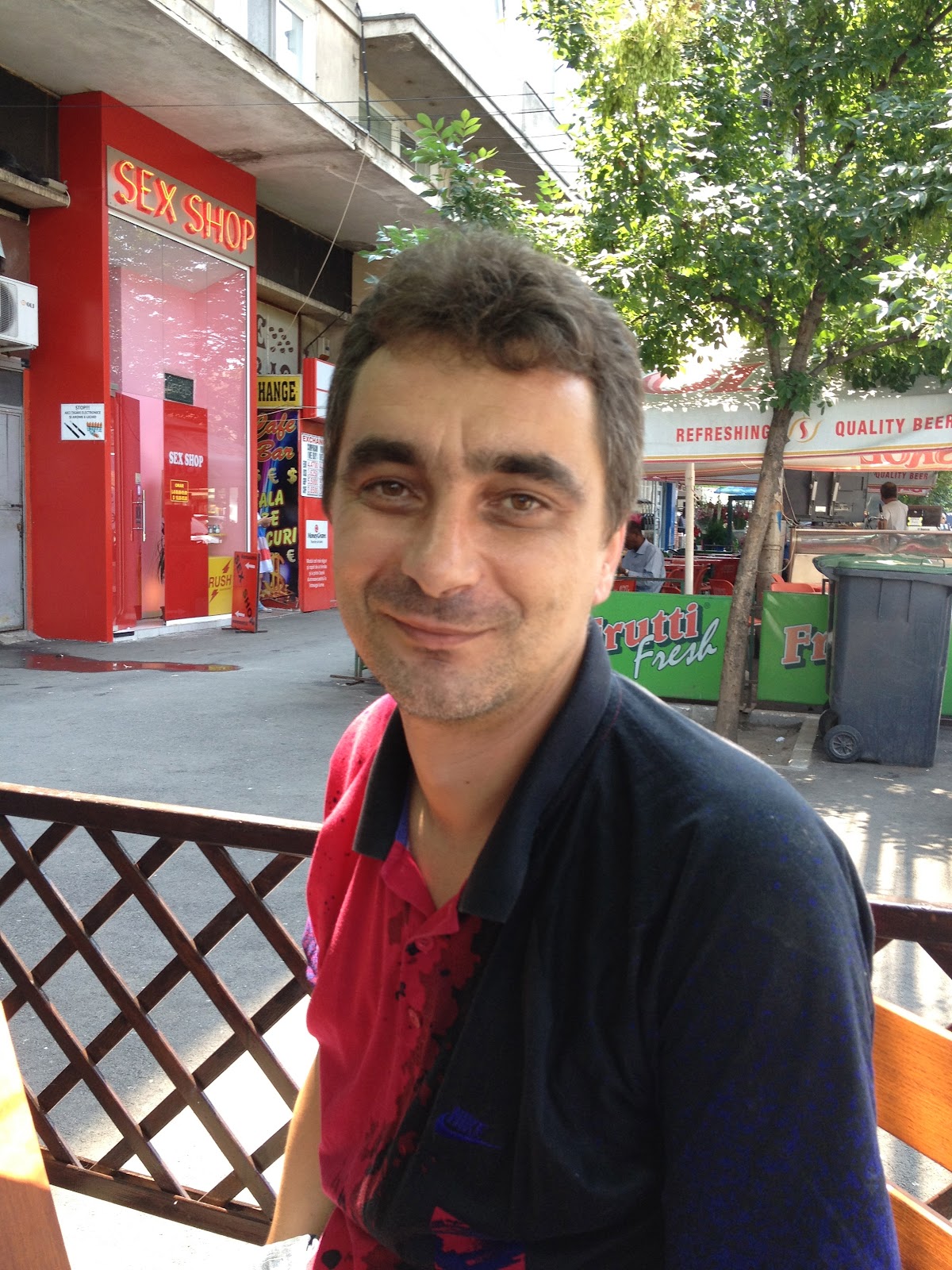
YALTA, UKRAINE Taras took me on a tour of the Swallow’s Nest and Tsar Nicholas II’s Livadia Palace on the Black Sea where Roosevelt, Churchill, and Stalin decided the fate of Germany and much of the rest of the world. Taras had a lot to say.

Taras
People accuse Roosevelt of selling out to Stalin, but I think he ended the bloodshed. If he had not made the concessions he did, Stalin would have continued his push west. Although the cold war was bad, at least lives were saved. We in the East suffered the consequences, but it could have been worse. We have a corrupt government now. It’s made up of millionaires and billionaires. They steal from the people. Their families live and travel abroad. They drive Bentleys and Ferraris. If they don’t like you or if they want your business, they simply trump up charges against you and throw you in jail. It’s disgusting. With Yulia Tymoshenko as Prime Minister it was better although corruption was still a big problem.

Life expectancy for men in Ukraine is only 62 years. Men generally don’t live to retirement. The problem is cheap alcohol, which the government produces and distributes. It’s easier for the government to deal with drunken people than productive ones. Unfortunately, people would rather drink, and not think about anything, then take responsibility for their lives. For democracy to work, people must take responsibility. We are a long way from meeting that objective. Poland and the Czech Republic are countries we need to emulate. They’re doing it on their own. They immediately tore up their past relationship with Russia, tore down their statues of Lenin and Stalin. We need to do the same here. Western Ukraine has become more like them, but here, we still have our statues of Lenin. It’s the same in Russia. The majority of people there voted for Putin. Yes, hundreds of thousands protested, but millions more sat at home, watching television, drinking beer, and waiting to be told what to do. In 1932 and 1933 when Stalin destabilized Ukraine’s nationalist movement through forced starvation, maybe as many as ten million people died, he relocated thousands of Russians to Ukraine, resulting in Ukraine becoming more like Russia in its culture and language. Everybody now speaks Russian and the majority of us long to return to the days when Ukraine was a part of the United Soviet Republic.

Economic conditions here are tough. A teacher makes about $300/month. They must work second/third jobs to make ends meet. I make $2,000 per month, running my own service business, which is at the low end of the average income scale. My girl friend is a lawyer and makes only $500 per month. Retirees get about $200/month. I’m hoping the Internet and the global economy will force changes as more people are exposed to a wider range of ideas and opportunities, but I’m afraid we have to wait on the younger generation to make it happen. I’m 29 and spent two years in Florida, where I learned things work pretty much the same no matter who’s in charge — you still have the same laws, same services, and same opportunities. That’s the way it should work here, so that it’s up to you what you make of yourself. Here I have two apartments, one I live in and the other I rent out. I’m doing okay, but I’d like to make more so that I can travel abroad more than just occasionally.

Sunday, July 22, 2012

Drinking Buddies


Vladimir & Igor
FEODOSIA, UKRAINE It looked like a great chance to get the inside street scoop on Ukraine and Russian politics, but Vladimir and Igor, my drinking buddies, didn’t have any interest in politics – they say they don’t even vote. Vladimir owns a trucking company, a total of seven trucks, running between Moscow and Yekaterinburg, and Igor, a retired Russian army doctor, owns the hotel/spa where I’m staying. Their English was virtually non-existent so what I learned about them, between drinking wine and downing vodka shots, was through Veronica, my trusty eleven-year old translator, who you met in my last blog. Igor who’s originally from Vilnius, Lithuania, has lived for extended periods in Russia and Poland. He bought the hotel five years ago because taxes here are ten times less than what they are in Lithuania. That is about the extent of the information I could glean from the two of them, not all that interesting, but then I didn’t understand a word of what they were saying as they chatted amongst themselves and the other guests and relatives as they came and went. What I did learn was how to drink Russian style, where before every sip you clink your glasses and toast to whatever: love, good health, long life, happiness, etc. And I learned to eat a piece of cucumber after every shot of vodka. Not sure what the purpose of that was, but it didn’t taste that bad, so what the heck. I also learned a few words in Russian: thank you, hello, goodbye, yes, no, and water without gas. “Water without gas” has become a very useful phrase, as people here prefer water with gas – ugh! The one phrase I have not been able to master is “good morning.” Whenever I try saying it, I get a puzzled look or a head shaking, “No speak English.”

Friday, July 20, 2012

Electronic Closets


FEODOSIA, UKRAINE Sometimes you collect information from the most unlikely of sources — this time from a precocious eleven-year old girl vacationing with her mom and relatives at a small resort hotel on the Black Sea. Her father is with the Ukraine embassy in Kenya from where she had just returned after a year there, learning English, and now speaking it almost flawlessly. Here’s what she had to say.

Veronica
Veronica: I prefer to speak English and Russian, but, of course, I speak Ukraine with my grandmother, because that’s all she knows. At home we speak Russian. Like Ukraine it’s our mother tongue although my younger sister doesn’t really speak Ukraine. She speaks Russian and English with an African accent. I want to learn French next. My English teacher was from California and says I speak American English. I know San Francisco and the Golden Gate Bridge. I know President Obama. I think he’s a good president. But I’m glad to be back in Ukraine. It’s my home and I like it here and although it’s near Russia, it’s part of Europe. I don’t think Ukraine will become part of Russia again, because we have our own president. I didn’t like Kenya. It’s a very poor country with people sleeping in the streets. There are a lot of monkeys, lizards, and insects there. It’s dangerous too. If you roll down your car window, the poor people will steal the necklace off your neck. I don’t like Mr. Mwai Kibaki, the president of Kenya. He’s a bad president because he keeps the people poor. I don’t care for the dark people there, or the Catholics, and I don’t like the Muslim women with their masks — you can only see their eyes. The Ukraine consulate in Kenya is small — the American consulate huge. When I grow up, I don’t want to work in the embassy. I want to be a translator and a designer. I want to design dresses. When I’m your age we’ll have electronic closets so all you need to do, for example, is type in “party” and the closet will return the right dress. Later, Veronica became the resident translator as I was invited to have dinner and drinks with the owner of the hotel and some other guests, all Russians, none of whom spoke English. 

Thursday, July 19, 2012

Muslims Speak Out


A Muslim's View
MYKOLAIV, UKRAINE I could have written something like this blog last year in Morocco or the year before in Turkey. The sentiments I heard in those countries were identical to the sentiments I picked up at a café in Mykolaiv, Ukraine. Two men and a woman sitting at the next table, speaking in broken English, caught my ear. “Where are you from?” I asked. The men, Abraham and Mamet, said they were from Turkey. The woman, whose name I didn’t get, said she was from Ukraine. Here’s what they had to say:

Abraham: I’m here to see my girl friend. We met over the Internet. Mamet: I came along just for the fun. Don’t know if I want a woman. Just looking, you know. Woman: I don’t know, maybe I go to Turkey with Abraham. I’m Christian. He’s Muslim. I must decide. Perhaps Ukrainian women deserve a separate blog, but what interests me here, is the direction our conversation then took. Abraham: I was in New York, fabulous city, never shuts down. But, people in America look at you different when you tell them you’re from Turkey. Like, oh, you’re one of them. You know, one of those terrorist type guys. I’m Muslim, and like most Muslims, I wouldn’t hurt a flea. It’s in the Koran. It’s what we’re taught. Mamet: You know, sir, it’s not true. You know, the way they report on what happened to the twin towers. The CIA did those attacks so they could attack Middle East countries and get their oil. Osama bin Laden and al-Qaeda were invented by the CIA. Abraham: Yes, it’s true. Bruce Willis, you know, that movie star, he agrees and there’s a lot of research that proves it. You know, why weren’t any bodies found from the planes that crashed?  Mamet: Why didn’t the U.S. fighter jets shoot the planes down? And, where are all these supposed al-Qaeda members? They don’t exist. They’ve been made up. Abraham: You know, everyone in the U.S. drives a big car and gas there costs less than $2 a gallon. The U.S. needs Middle East oil because they consume so much. As soon as I answer one question, they come back with another. 9/11 conspiracy theories, stoked by people like Bruce Willis, take on a reality of their own in the Middle East, providing a soothing explanation to the beleaguered collective Muslim psychic, which cannot, and rightly so, tolerate the implied guilt by association so many Americans would want to assign to them. Their sensitivities are not without justification as I recall the many Islamophobic statements made by the candidates during the Republican primaries: Rick Perry suggesting that Turkey is ruled by terrorists, Sarah Palin tweeting that a mosque at ground zero is an unnecessary provocation, Michelle Bachmann claiming that not all cultures are equal, meaning Islam, Herb Cain refusing to appoint Muslims to his administration, Newt Gingrich vowing that Muslims in his administration would have to take a loyalty oath, Rick Santorum’s insisting that America is at war with Islam, or Romney suggesting that not just al-Qaeda, but Shia and Sunni are the problem. So Abraham and Mamet have it right and it’s no wonder they react with bewilderment and pain and like others in the Middle East resort to insane conspiracy theories to deflect the prejudices that are hurdled at them.


Monday, July 16, 2012

An Ordinary Hotel Key

ODESSA, UKRAINE

Oliga: Good day David! Unfortunately you forgot to give the keys to the rooms Hotel Jumbo. Please could you send me them back through the train. Thanks in advance and hope to understand. It wasn’t the first time I had left a hotel with my room key. In Europe, at least, some of these keys could be heirlooms. That was not the case with this very ordinary key, but the desk clerk had otherwise been very helpful and had told me she was new on the job, so I responded to her email. The email exchange that follows has been partially edited for readability.

Me: I'm sorry I forgot to give you the key. I will try sending it to you from my hotel here in Odessa tomorrow.

Oliga: I am very grateful to you if you do this. I really hope that you will send the keys to the hotel. So I will not have problems with the boss because I really need this job. Thanks again.

Me: I'll definitely have it mailed to your hotel tomorrow. Please accept my apologies and tell your boss that it was not your fault.

Oliga: Thank you very much, but it's my fault. I hope that everything will be good. Please contact me and then when the parcel arrives that I know and tell the girls at the hotel. Have a nice evening.

Post Office Address
Me: I'm sorry to report that I haven't been able to find a way to send the key to you. The hotel tells me that the post will only accept documents. It's possible that I could use Fed Ex or DHL, but their offices are nowhere near the hotel where I'm staying. You mentioned something about sending by train, but I don't understand how that works. If you can explain better, that may be a possibility. I didn’t mention to Oliga that I had spent an hour looking for a post office just in case the hotel was wrong. Whenever I asked, “Where’s the post office?” I got a puzzled look. The best I could do was find something that looked like a telephone booth although it was clearly marked on my map as a post office.

Oliga: Good day David! There are many options for how to transfer the keys. Can pass through the train to from Odessa to Chisinau to provide the key guide and when I come, or by minibus, but better by train.

Oliga: If you pass the keys to the train. They called me and I will come to train.

Oliga: I beg you please try to transfer the keys.

Me: I'm afraid I don't understand. Who do I give the key to?

Oliga: Woman who works in a train. When you go to the train, she looks the ticket (the controller). You can ask her and she will give in Chisinau, I'll give her the money for it.

Me: What train? What time?

Oliga: Today at 16.50 will train from Odessa to Chisinau. I do not know the train number, but it is the train on which you are traveling. In Chisinau, he will be 21.44. You can pass either through the passengers or the conductor with my phone number and I'll be in the evening at the station.

Me: Okay, I gave the key to the train steward. I also gave him 22 lei. Please let me know if you receive it. It's now 12 p.m. I haven't heard back from Oliga. 

Sunday, July 15, 2012

Just Take Bus 106


Mini Buses
CHISINAU, MOLDOVA The hotel desk clerk tells me, “To get to the city take either the mini bus 106 or 160." The mini buses are all over the place, stopping whenever someone flags them down, and then continuing on some pre-planned, route, with which only the locals seem familiar. In minutes 106 appears. I flag it down, hop aboard, and give the driver three lei, less than a quarter. It looks like the right bus as the sign next to the 106 reads Piata Centrala and although the driver makes a variety of turns, I believe we’re heading in the right direction. So far so good — but then we come to a busy intersection where another bus pulls up beside us. The two drivers roll down their windows, talking and gesturing. They reach some sort of agreement and the passengers on the bus begin transferring to the other bus. “What the heck is going on?” But no English here, so I dumbly follow the crowd. The new bus takes a turn. It’s the wrong direction! I’m sure. The other passengers show no concern and continue to get on and off as if by plan. The bus finally stops. We are in a sparsely populated area with only a few buildings around. The passengers get off. I wait to talk to the driver. I point to the sign on his window. “Centrala! centrala!” He shakes his head, gesturing and talking rapidly. I keep pointing at the sign, “Centrala!” Ah, finally he appreciates the fix I’m in and motions me to sit down. Alone we drive another fifteen minutes farther outside the city, where we arrive at a place where a number of mini buses are parked, their drivers relaxing in the shade. My driver talks to one of them, who finally nods his agreement and motions for me to get in his bus. Half-hour later we arrive at the Piata Centrala, and all this for less than two bits. I suppose from this you might guess that Chisinau is not somewhere you’d expect to run into many Americans, but that evening I did, on two separate occasions, and here’s what they had to say.

David with whom I had a beer: "I’m a bank examiner from Oklahoma on assignment here by the U.S. Treasury Department. These assignments are one to two months long and can take me just about anywhere in the world. My job is to help governments examine their banking books, establish policies to thwart corruption, and to analyze and report on the effectiveness of U.S. Treasury’s investments. A big issue is corruption, but then that’s true everywhere including America. We call it lobbying. The Treasury Department funnels money into a lot of projects. The folks back in Oklahoma might be dismayed to learn where their taxpayer dollars are going — building of a Mosque, fighting AIDs, or the distribution of birth control. Moldova is a very poor country — per capita income around $3,000. In five years it will definitely join the European Union, but it will probably have to give up Transnistria in order to do so. Might be easier if Moldova belonged to Romania. That’s where it belongs anyway. I’m sure it won’t become part of the Russian Federation again. Democracy here has developed too far, and the hard feelings toward the pre-independent days still linger."

Pat with whom I had dinner: "I’m a zoologist with a PhD from the University of Florida. I work as independent contractor conducting bio-diversity studies for the U.S. State Department. These assignments can take about a month and may be anywhere in the world. I usually do two or three a year. The rest of the time I write an article on bio diversity for my hometown newspaper in Florida. It’s kind of a nice setup that allows me to travel and do something I care about, without having to be away from home that much. I’m here to do research and write a report on a sturgeon caviar farm in Transnistria. The U.S. State Department wants to know what’s going on and whether it's meeting the obligations under the Convention on Biological Diversity, to which Moldova is a signature. The State Department may use this information to determine if they want to fund certain projects here. Since Transnistria is a place like no other place, having its own currency, political system, and yet not recognized as a country by anyone, I’m going there incognito, as a tourist. No one is to know I work for the State Department. It's an odd place. The people there don't even have passports. To leave they must use another country’s passport, like Ukraine or Russia."

Friday, July 13, 2012

Moldovian Crossing


Changing Wheels
MOLDOVIAN BOARDER It’s four in the morning. Someone is tapping on my foot. The cabin light flicks on. For a moment I forget where I am. I was sound asleep. Groggy, I recognize the train’s steward. He says, “pass,” probably the only English word he knows. Okay, I need to get out my passport. The steward leaves and fifteen minutes later a Romanian border guard comes by and takes my passport. Then nothing for an hour, until the Romanian border guard comes back with my passport and the train starts to move, slowly, for just a few minutes, then stops. I had closed my cabin door, thinking we were through. There’s another knock on the door. A woman in street attire points at herself and says, “doctor.” Then points at me, “problem?” I shake my head and she moves on. Uniformed men are now patrolling the corridor. A Russian soldier, that’s what I suspect anyway from the Russian star on his cap, motions for me to give him my passport. He studies it very seriously, and says something in Russian. It seems he wants to know where I’m going. I show him the numerous visas in my passport. He says something in Russian. I think he’s asking me, how long am I staying in Moldova. I hold up two fingers. He proceeds to page through my passport several times, with a curious frown, looking for something, I don’t know what. Finally he runs my passport through his computer and hands it back to me. I say Spasiba. He nods with a smile and moves on. A moment later another uniformed official, from which country I'm not sure, asks me to open my bags. He looks the contents over, satisfied, moves on. The train starts up again, moving slowly, stops for a few minutes, then backs up, and stops. There’s a loud clang outside, lots of commotion. Workers are changing the wheels on the train. We are now on the Russian rail system, whose track gauge is different than that of the West, a system that Tsar Nicholas I in the 1840s mandated so that their enemies could not use Russia’s rail system to attack them.

After the interminable delay we finally head into Moldova. Due in part to the lengthy boarding crossing, the train from Bucharest to Chisinau takes over thirteen hours. The train is old and has zero amenities: no air conditioning, no electrical outlets, no diner car, and toilets that dump their refuge on the open tracks below. It’s not for your everyday traveler. From Marius I learned that Moldova was once part of Romania. They speak the same language and use the same currency. It turns out he wasn't correct with respect to the currency. So don't believe everything you hear. Now in theory, at least, Moldova is an independent country although the northern region, Transnistria,dominated by Russians, wants to break away and become a part of the Russia Federation. Curiously, I don’t need a visa here, but I do need one for Russia. Yet it’s the Russian officials that controlled the border, and the tracks are Russian. So is Moldova Russian, Romanian, or independent? I put this question to the two desk clerks at the hotel where I’m staying. One said Moldova is Russian the other said we’re European. I also ran into a bank examiner working for the U.S. Treasury Department and he told me most certainly Moldova will become a part of the European Union. But I’m not so certain. If I were to put money on it, I would bet in a few years, it will return to Russia — just a hunch. 

Wednesday, July 11, 2012

Aren't You Lonely

BUCHAREST, ROMANIA The most frequently asked question I get is: aren’t you lonely when you travel alone? My answer is that I’m always bumping into someone with whom I can have a conversation and that often makes me feel more alive than talking with people I’ve known all my life. Today was a good example. After tramping through much of Bucharest alone, I stopped to get some lunch. The tables were full, so I asked a young man if I might share his table. His name turned out to be Marius and five hours later, after he had given me an extensive tour of the city, disabused me of most of my original impressions of Bucharest, and shared with me his opinions on everything from the Orange Revolution to Count Dracula, we parted company, each assuring the other that we would stay in touch. Because of Marius’ difficulty with English, I won’t attempt to capture all that we talked about and that had convinced me of his rich knowledge of history, philosophy, politics, and culture; I’ll just report on a few of the things he said that now stand out in my mind.


Marius
Orange Revolution: The West doesn’t understand what’s going on here. The current president, Traian Băsescu, is very corrupt and has mismanaged the economy. He bought $2 billon worth of used F-16s that are now mostly worthless and sold out our navy as well. Next to the President of Moldova, Băsescu is the last Orange Revolution president remaining. In two weeks we will have a referendum and he will be voted out. 75% of the people want him out. We are not like Ukraine; we are a democracy and will remain a democracy regardless of who our president is. The West needs to know this.

On America: America is the model of democracy for the rest of the world, but Obama is not a strong leader. On paper, of course, he is, but he doesn’t project this power to the rest of the world. I like him and think that he’s very smart, smarter than Bush. In the end, I think the American people will choose well whether it’s Obama or not. This is how democracy works. But for me America is inaccessible. I tried to get an America visa once, but the American consulate here in Bucharest turned me down. I guess I need to know someone in America.

Personal Situation: I have a Bachelors degree in social work, but not a paying job as a social worker. I volunteer my time helping disabled children. To put food on the table, I own a small distributorship while my wife works as an English language translator. Together we make 1,000 Euro per month, hardly enough for a family of three to live on. Unfortunately, although we’re a part of the European Union, it’s impossible for us to get a job in another European country. They think we’re gypsies. I’m not, but that’s what they think, and they don’t like gypsies. Not all gypsies are bad, just as not all Romanians are good. I don’t understand why people don’t get that.


Tuesday, July 10, 2012

A Dog Problem


BUCHAREST, ROMANIA Daniela, a young 20s something Bulgarian with a degree in economics and statistics, fluent in English, sat next to me on the flight from Frankfurt to Bucharest. Here’s my account of what she had to say:

Daniela: "I’m returning from Norway for some vacation time at home. It’s always raining in Norway. I was there looking for a job in the Government, but they told me my Norwegian wasn’t good enough so I need to work on it some more. I need to find a job in Norway because the pay is better there. In Bulgaria, the pay is terrible and there aren’t as many job opportunities. Since the wall came down, the situation in Bulgaria has gotten worse. There’s no respect for authority. People feel they can do whatever they want. There’s a lot of corruption. We have a dog problem. Actually it’s not a dog problem; it’s a people problem. People get dogs that they can’t take care of, let them loose, and then they run wild. I volunteer to get dogs fixed, but it’s an uphill battle because more and more people are letting their dogs free."

Peter, a young man in his 30s, speaking halting English and looking like he hadn’t taken a bath in a month, helped me get from the airport into the city, a trip that exposed the sad and backward conditions of this country. Here’s my account of what he had to say:

Stray Dog in Bucharest
Peter: "I’m returning from Scotland. I got a job there picking up used clothing, but didn’t get paid. The agency that got me the job said they couldn’t do anything about it. The only reason I’m able to get home is because I have a credit card. There are some jobs in Romania but they don’t pay anything. The situation here isn’t any better now than it was before Nicolae Ceauşescu. I come from a town 400 kilometers from Bucharest. I’m actually Hungarian. I have a Hungarian passport and a Romanian ID. A Hungarian passport is better than a Romanian one. It gets you into far more countries. There are two million Hungarians living in Romania. We should be a part of Hungary as we were before 1945. Like Bulgaria we have a dog problem too. A few years ago they tried to get rid of the dogs, but Brigit Bardot stepped in with her animal rights group and put a halt to it. Now we have dogs everywhere.

Crisis in Europe

FRANKFURT, GERMANY Over a lunch I interviewed Julius, a former student of mine. We spoke in German. Although I recorded the interview and am therefore in a position to cull some of the more pertinent details, I take full responsibility for any misrepresentations that I may have made.

Julius On the Euro Crisis: I’m no friend of the CDU but I’m impressed with the way Frau Merkel has managed the crisis here in Europe. It’s noteworthy the way she has held her coalition together. She is very popular and trusted here in Germany. I hope Europe acts reasonably and depends not just on one country to solve its problems. In the end though, Germany must pay. It can’t be otherwise. This is a challenge for Frau Merkel to bring her own party to accept this. The SPD is clear that we are an export country and we need the Euro to remain competitive. We don’t have an industrial crisis. We have a financial crisis. The banks have made risky investments and now they have to write these investments off and we must pay. That’s crazy. Banks have not just been greedy they’ve been stupid. Every bank apprentice knows that the customers’ deposits must be protected. The banks dare not engage in risky investments. What Germans fear most though is inflation. My grandfather was a very successful banker, a millionaire, who was the co-founder of a bank, and lost everything in 1923 due to hyperinflation. The solution to the Euro crisis is difficult. We must have agreement among the European countries regarding structural matters. The Greeks must pay their taxes. France’s concern is unemployment and that is understandable. There were six million unemployed in Germany when Hitler came to power. Keynes had argued that during a crisis such as this more spending is required. All this needs to be better explained to the German people. We need a good communicator like a Reagan. Unfortunately, this is not Merkel’s forte.

On America and Social Issues: The tea party and the religious right in America seem to want to return to the 50s, to McCarthyism, not against communism per se — but against others. They seem to be on a witch hunt and want to return to some earlier time, “ein reinkultur” when there was supposedly no separation between church and state. They want to teach creationism in the schools. That’s crazy. This is a Country that has landed people on the moon. How can they be so stupid? Sometimes I wonder whether these people are for real? Do they really believe these things or do they just say anything to defeat Obama. Here in Germany their issues are impossible to understand. Here, the government stays out of these issues and leaves them to the individual to decide according to his or her conscience. Gays can marry here and it’s quite normal. The only thing where the law is clear is that stores must close on Sunday. Not all stores though, bakeries and flower shops can stay open. [Julius chuckles] We need our Kucken on Sundays, you know, and, of course, be able to buy some flowers as a gift, but this has nothing to do with the church, but protection for employees from their employers. It’s the tradition here. Upon concluding our interview Julius suggests we stop by the Alte Nikolaikirche, an Evangelical church, where he makes a habit, when in the area, of lighting a candle.